Langkau ke kandungan


Pertumbuhan rambut adalah salah satu peluang pertama yang diperhatikan oleh banyak jenama apabila memasuki penjagaan rambut. Keperluan itu mudah dikenali, the products are highly visible online, and rosemary oil, kafein, biotin and peptides already have name recognition. That visibility can make the category look easier than it is. The first brief we receive is often a list of popular ingredients copied from successful products, but a list of actives is not yet a product strategy.
Before I recommend a formula, I need to understand who the customer is, whether the concern is scalp condition, visible thinning, weak hair or breakage, where the product will be sold, and how far the brand intends to go with its claims. A lightweight peptide serum created for a skincare audience should not feel like a rosemary pre-wash oil made for TikTok. A professional scalp concentrate has a different job from a value-driven shampoo sold on Amazon.
Jawapan pantas: For most private label brands, the strongest hair growth opportunity is a treatment-led range built around a leave-on scalp serum or scalp oil, supported by shampoo, conditioner or a weekly scalp treatment. Scalp serums are showing particularly strong retail growth, while rosemary oils have demonstrated their ability to generate large sales volumes through TikTok and Amazon. The right product should be selected according to the target customer, channel, price point and claim requirements—not simply because an ingredient is trending.
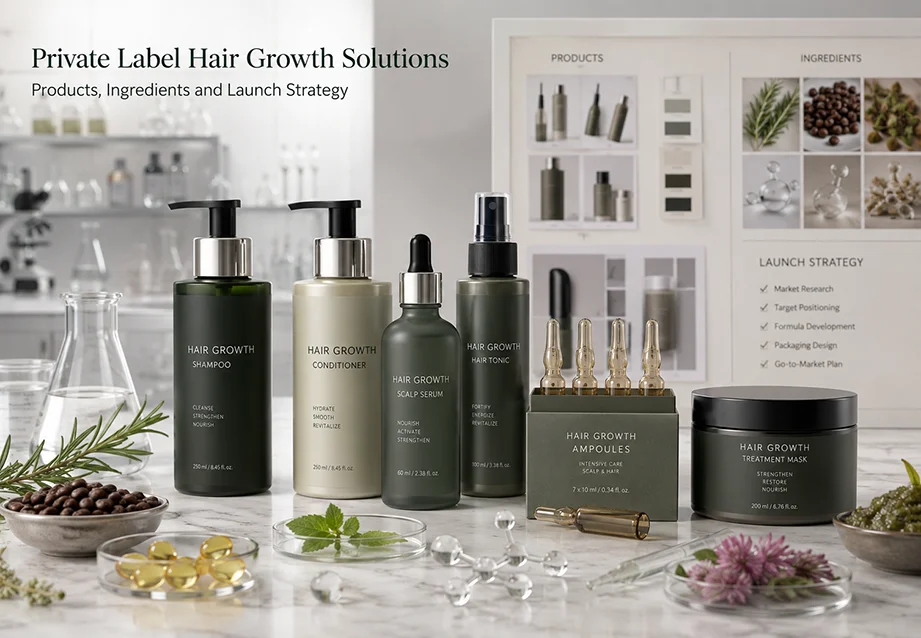
Why Hair Growth and Scalp Care Deserve Attention
The opportunity is broader than a short-lived social media trend. Scalp care has been developing into its own treatment category as consumers bring skincare habits—serums, pengelupasan, barrier care and ingredient research—into their hair routines.
Circana reported that hair was the fastest-growing U.S. prestige beauty category by dollar sales in 2025. Hair treatments helped drive that performance, scalp care recorded its third consecutive year of double-digit growth, and online accounted for the majority of prestige hair sales. (Circana, A.S. prestige and mass beauty performance in 2025)
During the first half of 2026, prestige hair sales in Canada rose 23% year over year. Hair serum increased 91%, daily-rinse shampoo 22% and conditioner 20%, giving brands a solid reason to look beyond shampoo and consider a leave-on product as the center of the range. (Circana, Canada beauty sales in the first half of 2026)
Marketplace behavior points in the same direction. BeautyMatter’s analysis of Amazon beauty performance in Q2 2025 reported more than 1.1 million monthly searches related to hair growth. The average price of the Haircare Top 10 was $19.17, showing both strong interest and a value-conscious competitive environment. (BeautyMatter, Amazon Q2 2025 Atas 25)
Nature Spell provides a social-commerce example: it reportedly sold one million orders within 12 months of introducing its rosemary oil treatment on TikTok Shop, while annual sales later grew from less than £1 million to £24.6 million. The brand turned a familiar ritual into an affordable product creators could demonstrate easily. (The Sunday Times, Nature Spell company profile)
Taken together, these signals suggest three things. Leave-on treatments deserve priority, ingredient-led discovery is commercially important, and the route to market should influence the product from the beginning.
Start With the Hair Concern, Not the Ingredient Trend
“Hair growth” is a useful search phrase, but it is too broad for a laboratory brief. Consumers use it for several different experiences: an oily or uncomfortable scalp, hair that keeps breaking, fine hair that lacks fullness, excessive shedding, or a diagnosed form of hair loss. Those concerns do not lead to the same formula.
A scalp-care line may focus on cleansing, hydration and comfort. An anti-breakage range is more concerned with conditioning and length retention. Fine hair usually needs lightweight products that do not flatten the roots, while an advanced density project may justify a peptide serum or professional concentrate with a stronger evidence plan.
The strongest brief chooses one primary concern and perhaps one supporting benefit. Trying to address oil control, kekeringan, pecah, density, dandruff and medically defined hair loss in one formula produces a crowded product that is difficult to explain and substantiate.
Hair Shedding, Hair Loss and Breakage Are Not the Same
This is one of the most useful distinctions a brand can teach its customers. The American Academy of Dermatology notes that losing roughly 50 kepada 100 hairs a day can be normal. Excessive shedding may appear after childbirth, major stress, fever, illness, surgery or substantial weight loss, often several months after the event. It can be temporary when the trigger resolves. (American Academy of Dermatology, hair loss or hair shedding)
Hair loss is different. It can occur when something interferes with growth and may be associated with hereditary factors, immune conditions, medication, medical treatment or hairstyles that continually pull on the roots. Breakage happens along the hair fiber rather than representing the same process at the follicle. Heat, chemical processing, rough detangling and repeated tension can all make fragile hair more likely to snap. The AAD advises limiting excessive heat and tight styles and handling vulnerable hair gently. (AAD, hair styling without damage)
Untuk pembangunan produk, this changes the answer. A conditioner or mask can support detangling and reduced breakage. A lightweight serum can support scalp condition and the appearance of fuller hair. Neither should be presented as a diagnosis or treatment for every reason a consumer may be losing hair.
Six Private Label Hair Growth Product Opportunities
1. Daily scalp density serum
If a brand wants a hero product, this is where I would usually begin. The recent retail growth of hair serums supports the opportunity, but the format also makes sense from a product-development perspective. A leave-on serum stays in contact with the scalp, fits into a daily routine and can carry more perceived value than shampoo.
Possible concepts include a multi-peptide density serum, a caffeine and niacinamide serum, a sensitive-scalp formula or a lightweight botanical treatment. The real development work is in how it behaves in hair: it should reach the scalp, spread easily and dry without greasy roots, flakes or sticky patches. Fine and textured hair may require different sensory choices, so “suitable for all hair types” should not be added casually.
Packaging also affects the result. A glass dropper looks familiar to skincare consumers, but a precision nozzle or controlled pump may reach the scalp more effectively. The applicator should be evaluated with the final viscosity rather than selected from a photograph.
2. Rosemary pre-wash scalp oil
Rosemary oil has a commercial advantage many laboratory ingredients do not: consumers already know its name and understand the ritual. The performance of brands such as Nature Spell shows how well the format can work when product, price and short-form content align.
Untuk projek label peribadi, the opportunity is more than mixing rosemary essential oil with a heavy carrier. Development needs to address strong odor, difficult washing, greasy roots, irritation, oxidation and leaking packaging. A brand might choose a lightweight pre-wash oil, a richer textured-hair formula or a balanced botanical blend. A comb-tip applicator may create a useful TikTok demonstration, but it still needs to dispense a controlled amount without pulling the hair.
3. Peptide scalp serum or professional ampoule
Peptides give brands a more science-led direction. In data reported for Allure’s 2025 hair-trend outlook, Spate found approximately 9,200 average monthly Google searches combining “hair” and “peptides,” while peptide-related #hairgrowth posts averaged about 64,500 weekly TikTok views. (Allure, hair-care trends for 2025)
This opportunity is better suited to a premium serum or professional treatment than to adding a trace amount of peptide to every SKU. The laboratory can explore combinations with caffeine, niacinamide, amino acids or soothing ingredients while the brand builds a focused scalp or density story.
Supplier data matters here. Branded active complexes are often supported by studies conducted at a defined concentration and under specific conditions. If a formula uses less than the studied amount or changes the surrounding claim, the strongest supplier conclusion may no longer apply. Trademark use, exclusivity and permission to reproduce supplier graphics should also be checked before packaging is designed.
4. Scalp-balancing or strengthening shampoo
Syampu remains an easy point of entry, and the 22% Canadian growth reported for daily-rinse shampoo confirms that familiar formats still matter. It can bring customers into the range, support bundles and create predictable replenishment.
The role of shampoo needs to be realistic. Because it is rinsed away quickly, I would not ask it to carry the entire density proposition. Consumers judge shampoo immediately on foam, pembersihan, wangian, rinsing and the condition of the hair afterward. A fashionable active will not rescue a product that leaves the scalp tight or the lengths rough.
Potential directions include caffeine, rosemary, niacinamide or amino-acid shampoos. Anti-dandruff claims require separate regulatory consideration in markets such as the United States, so they should not be added simply because the shampoo is intended for the scalp.
5. Anti-breakage conditioner or hair mask
Conditioner sales grew 20% in the Canadian data, but its strategic value goes beyond that number. A hair growth range that talks only about the scalp can ignore why many customers struggle to retain length. Hair may be growing normally while the mid-lengths and ends continue to snap.
Depending on the audience, the formula could use amino acids, hydrolyzed proteins, panthenol, seramida, plant oils or an appropriate conditioning system. Fine hair may need a light rinse, while chemically treated or textured hair may need a richer mask with greater slip.
This is also one of the clearest places to build a measurable cosmetic claim. Rather than promising new growth, the brand can explore testing related to combability, breakage or stronger-feeling hair. The test design still needs to match the wording used on the finished product.
6. Scalp exfoliating treatment or professional concentrate
A pre-shampoo scalp treatment gives skincare brands a natural way into hair care. Formats can include a salicylic-acid scalp liquid, PHA serum, cleansing gel, oil-control treatment or weekly scalp mask. The cosmetic story should remain focused on buildup removal, freshness and preparing the scalp for the next step. Saying that exfoliation “unblocks follicles to grow new hair” creates a much more difficult claim.
For SPA and salon clients, I would take a different route: a professional concentrate or ampoule used during a defined protocol and supported by a home-care serum. The project also needs application quantities, treatment time, massage steps, staff instructions and workable professional margins.
What Cosmetic Hair Growth Products Can—and Cannot—Do
Cosmetic scalp and hair products can cleanse and condition the scalp, improve moisture and manageability, help reduce breakage, and make hair feel stronger or look fuller. Those are meaningful benefits when the formula and evidence support them. They can also make a routine easier to follow, which matters because consumers rarely judge a long-term care product after only one application.
They cannot diagnose why someone is losing hair or promise to correct every underlying cause. A shampoo, oil or cosmetic serum should not be presented as a substitute for medical assessment of hereditary hair loss, alopecia, nutritional deficiency, illness or medication-related changes. Teaching that limit does not weaken the product. It gives the brand a more credible role: supporting scalp and hair condition without pretending that every consumer has the same problem.
Hair Growth Ingredients Consumers Recognize
A popular ingredient can help consumers understand a product, but it does not automatically substantiate the finished product’s claims. I prefer to treat ingredient popularity as a commercial signal and then evaluate the technical evidence separately.
| Ingredient direction | Commercial role | Suitable formats | Development caution |
|---|---|---|---|
| Rosemary oil | Strong social-commerce recognition and an established hair-oiling story | Scalp oil, pre-wash treatment, syampu | Odor, irritation, oxidation, dilution and oiliness |
| Peptida | Premium, science-led positioning with growing search interest | Scalp serum, professional ampoule | Use level, supplier evidence, trademark and claim scope |
| Kafein | Familiar density-care ingredient that pairs well with lightweight formats | Serum, tonic, syampu | Presence in a formula does not itself prove hair growth |
| Niacinamide | Connects hair care with skincare and scalp-balance language | Scalp serum, syampu, treatment | Best used within a clear scalp-care concept |
| Panthenol | Recognizable support for moisture, conditioning and stronger-feeling hair | Syampu, serum, perapi | Usually a supporting ingredient rather than the hero story |
| Redensyl, Capixyl, Procapil or AnaGain | Supplier-branded active systems for efficacy-led projects | Density serum, ampul | Review supplier data, permitted claims, trademarks and target concentration |
| Amino acids and proteins | Clear relevance to damaged, fragile and breaking hair | Perapi, topeng, syampu | More appropriate for anti-breakage than regrowth claims |
| Salicylic acid or PHA | Fits scalp exfoliation and “skinification” routines | Pre-wash liquid, kulit kepala lewat | Market limits and claims must be checked; avoid follicle-unblocking language |
| Biotin | High consumer recognition in hair products | Syampu, perapi, serum | Recognition is stronger than the evidence behind many topical marketing claims |
Untuk banyak jenama, the best formula combines one ingredient consumers recognize with supporting ingredients chosen for sensory performance and scalp or fiber condition. Adding every fashionable active can increase cost, destabilize the formula and make the marketing story harder to understand.
How the Products Work Together in a Consumer Routine
The products in a hair growth range should not repeat the same claim. Each one needs a clear place in the routine.
A pre-wash oil or exfoliating treatment is used occasionally to condition the scalp or loosen buildup before cleansing. Shampoo removes oil, sweat and styling residue. Conditioner or a mask supports detangling and reduces the friction that contributes to breakage along the lengths. The leave-on serum then carries the main daily scalp-care or density story.

Usage instructions should reflect the actual formula. Applying more oil does not make it work faster, and overusing a strong scalp exfoliant can undermine a comfort-led positioning. Brands should state where to apply the product, how much to use, whether it goes on a wet or dry scalp, whether it should be rinsed out, and how often it was designed to be used.
This kind of education also supports retention. A customer who understands why the serum goes on the scalp and the conditioner stays mainly on the lengths is more likely to use the system correctly and judge each product by the benefit it was designed to provide.
Which Product Line Fits the Business?
The same assortment will not work equally well for a skincare brand, an Amazon seller and a professional distributor. I would shape the first launch around how the product will be discovered and used.
| Business type | Recommended starting line | Why it fits |
| Skincare brand | Peptide scalp serum + weekly exfoliating treatment | Extends familiar serum and treatment language to the scalp |
| Product manager or established brand | Custom density serum + syampu + perapi | Allows performance differentiation and a complete routine |
| First-time private label founder | Scalp serum + syampu | Keeps inventory focused while testing demand |
| Amazon seller | Serum + syampu + conditioner bundle | Aligns with search behavior, familiar formats and replenishment |
| Shopify or DTC brand | Custom hero serum + one supporting cleanser | Concentrates storytelling and acquisition spend on one product |
| TikTok seller | Rosemary pre-wash oil with a visible applicator | Creates a routine that can be demonstrated quickly |
| Distributor | Syampu + perapi + serum + topeng | Offers retail clients a recognizable range across price points |
| SPA or salon brand | Professional ampoule + treatment protocol + home-care serum | Connects an in-service experience with repeat retail sales |
I would not ask a new brand to launch six SKUs simply to look established. Two products with distinct jobs are more convincing than six products repeating the same ingredient story. A first-time founder might launch a serum and shampoo, while an experienced professional brand may be ready for a treatment protocol and home-care range.
Label Peribadi, Semi-Custom or Custom Formulation?
The development model should be chosen product by product.
Private label is practical when a suitable formula already exists and the brand values speed, a more predictable cost and a lower development burden. It can work particularly well for a supporting shampoo, conditioner or first market test.
Semi-custom development can adjust fragrance, warna, tekstur, selected ingredients or the active story, although the meaning of “semi-custom” varies among manufacturers. The scope should be written down. A seemingly small change can affect preservation, kestabilan, keserasian pembungkusan, cost and MOQ.
Custom formulation makes sense when the hero product must deliver a texture, applicator experience, ingredient system or consumer benefit that existing formulas cannot provide. A premium scalp serum may justify this investment, while the shampoo beside it may not need to be built from zero.
Formula ownership is a separate contractual issue. Paying a development fee does not automatically give the brand ownership, exclusivity or the right to transfer production. Those rights need to be defined before the project becomes valuable enough for either party to dispute them.
Cosmetic Scalp Care or Drug-Level Hair Regrowth?
Brands should address claim classification before finalizing the formula and label. Di Amerika Syarikat, a product intended to treat or prevent disease or affect the structure or function of the body may be regulated as a drug. The FDA has specifically cited hair-restoration language among drug claims found on products marketed as cosmetics. (FDA, warning letters addressing drug claims for cosmetics)
Phrases such as “regrows hair,” “treats alopecia,” “reactivates dormant follicles” or “reverses pattern baldness” carry very different implications from cosmetic language concerning scalp condition, reduced breakage, stronger-looking hair or the appearance of fullness.
Other markets also require evidence and careful presentation. EU cosmetic claims must meet common criteria including truthfulness and evidential support, while UK regulators can consider ingredients, mode of action, pembungkusan, advertising, websites and social media when deciding whether a borderline product is medicinal. (EU cosmetic claims criteria; UK guidance on borderline products)
No short list of “safe claims” works for every formula and country. The wording needs to be reviewed against the complete product, evidence, target market and way the brand presents it online.
When consumers should seek professional advice
A responsible brand should not encourage consumers to self-diagnose persistent or sudden hair loss. Patchy loss, scalp pain, marked inflammation, sudden excessive shedding or an ongoing concern deserves advice from a qualified healthcare professional or dermatologist. The NHS similarly recommends seeking medical advice when someone is worried about hair loss and understanding the possible cause before approaching a commercial hair clinic. (NHS, hair loss guidance)
This guidance can appear on an educational page or in customer-support material without turning the product label into a medical leaflet. It sets an honest boundary between everyday cosmetic care and a concern that may need diagnosis.
What Turns a Trend Into a Market-Ready Product?
Ingredient popularity may generate the first click, but repeat purchasing usually depends on less glamorous decisions.
The formula must remain physically and microbiologically stable. Testing may include stability, kualiti mikrobiologi, preservative efficacy and packaging compatibility. An oil needs oxidation control, a water-based serum needs suitable preservation, and a mist must continue dispensing correctly as it ages.
Claims need their own evidence plan. Consumer studies, breakage tests, scalp measurements, instrumental assessments and standardized photography support different wording. The intended claim should be chosen before the study is designed.
Before-and-after photography is especially easy to distort in hair care. Lighting, part position, penggayaan, wash condition, camera angle and humidity can change the apparent density. A credible protocol controls these variables and uses an appropriate evaluation period.
Packaging must survive the intended channel. Amazon sellers need leak resistance and clear dosage, TikTok products need a visible but controlled application, and professional products need efficient sectioning. Because a custom applicator can carry a higher MOQ than the formula, brands should request separate minimums for bulk, pengisian, pembungkusan, decoration and cartons.
How Xiran Cosmetics Helps Brands Develop Hair Growth and Scalp Care Products
Di Xiran Cosmetics, we do not begin a hair growth project by asking a brand to choose five or six products from a catalogue. We first identify the product that should give customers a reason to choose the range.
Untuk jenama penjagaan kulit, that may be a lightweight peptide scalp serum. For a TikTok seller, it may be a rosemary pre-wash oil with a convenient applicator and a better wash-out experience. For a salon or distributor, it may be a professional scalp concentrate supported by retail home care. Once the commercial direction is clear, we can build the development plan around it.
Product planning and formulation
We can help brands compare existing formula label peribadi, semi-custom options and fully customized development for products such as scalp serums, tonik, rosemary oils, strengthening shampoos, perapi, topeng muka, scalp exfoliating treatments and professional concentrates.

During development, R kami&D team evaluates more than the ingredient list. We consider target cost, tekstur, penyerapan, hair-type suitability, wangian, keserasian aktif, permohonan, pembungkusan dan pasaran sasaran. For a hero serum, this may involve several rounds of sampling to refine dry-down and residue. For a supporting shampoo, the priority may be balanced cleansing and the condition of the lengths after rinsing.
Packaging and brand presentation
Kosmetik Xiran, can assist with bottle and applicator sourcing, including droppers, precision nozzles, pam, semburan, comb-tip applicators and professional ampoule formats. We can also coordinate logo application, label, cartons and packaging design.
The pakej is evaluated as part of the product rather than as a final decoration. Formula viscosity, oil resistance, pump output, leakage, keserasian, decoration durability and packaging MOQ all influence the choice.
Menguji, documentation and compliance support
We can coordinate appropriate formula testing and work with qualified third-party laboratories when product-specific efficacy or regulatory testing is required. Bergantung kepada projek, this may include stability, microbiological testing, preservative efficacy, keserasian pembungkusan, tolerance evaluation, consumer studies or claim-related testing.
Manufacturing documents can include the INCI list, certificate of analysis, safety data information, product specifications and available test records. Untuk projek antarabangsa, we can also support communication with third-party regulatory providers for requirements such as CPSR and PIF preparation, EU notification, A.S. MoCRA-related obligations and documentation for other target markets. The exact scope and third-party fees should be confirmed for each project.
Production and route to market
After formula and packaging approval, Kosmetik Xiran, supports scale-up, pembuatan pukal, pengisian, packaging and batch quality control. We can also coordinate warehousing, international shipping and later product-line expansion.
This connected process matters because the most common delays do not come from one dramatic failure. They come from formula, pembungkusan, ujian, artwork and market requirements being handled as unrelated tasks. Bringing those decisions together earlier gives a brand a more realistic cost, MOQ and launch schedule.
Fikiran Akhir
Private label hair growth is an attractive category, but the winning opportunity is rarely “another hair growth product” with a different logo. The brand needs a product consumers already understand and a reason for choosing this version.
Current retail data makes leave-on serums difficult to ignore, while social-commerce results show the strength of rosemary oils. Shampoo and conditioner keep the routine familiar, and peptides offer a more premium direction when the brand has the budget and evidence plan to use them properly.
The starting point depends on the business. A first-time seller may need a serum and shampoo, a TikTok brand a visually distinctive pre-wash oil, and a professional brand a protocol rather than a collection of retail bottles.
Pada Kosmetik Xiran, our role is to help turn that commercial decision into a workable formula, pakej, testing plan and production project. When those pieces support the same customer need, the result is more than a trending ingredient in a bottle—it is a hair and scalp care line with a clear place in the market.