Skip to content



Starting a makeup remover brand is one thing. Deciding what kind of brand to build is another.
You might already know that you want to sell makeup removers, but that still leaves a lot of questions. Should you use waterproof makeup? Make a gentle everyday cleanser? Create a product for professional makeup artists? And how do you know that customers really need another product in a category that already has so many choices?
From a manufacturer’s standpoint, I don’t think the formula is the best place to start. I want to know who you want to sell to and what they currently use and what is frustrating about their current makeup removal.
A cute packaging cleansing balm, it might seem like a great product idea. But if your customers are after fast and light removal of everyday makeup, that balm may not be what they’re after.
Ditto for micellar water, cleansing oils and eye-makeup removers. Each can be a good first product, if there is a clear reason for customers to pick it.
In this guide I’ll take you through six makeup remover brand ideas, how to research potential market opportunities and how to narrow down your options before investing in product development.

Quick Answer: How to come up with a makeup remover brand idea?
The first step to coming up with a good makeup remover brand idea is to identify a specific customer group and find out what they don’t like about existing products. Consider makeup habits, removal difficulties, preferred textures, convenience and buying behaviour. Potential niches could be everyday minimalist cleansing, waterproof makeup removal, comfort-focused cleansing, professional makeup removal, travel-friendly products and premium sensory cleansing.
If you have identified a problem worth solving, validate the idea with target customers before you settle on a formula or begin production. Your first product needs to be strong, meet a clear need, fit your budget and give a believable reason to choose your brand.
Start with your ideal customer, not your makeup remover formula
One of the easiest ways to unnecessarily complicate a new beauty brand is to start gathering product ideas before you’ve decided who the brand is for.
A founder might launch a cleansing balm because they like the texture, add a micellar water because it is familiar and include an eye makeup remover to make the range look more complete.
That may make for an attractive product catalogue, but it doesn’t necessarily make for a focused brand.
I like starting off with a specific customer and work backward.
Imagine a guy who wears waterproof mascara every day. The biggest frustration might be the need to rub their eyes repeatedly before their makeup comes off.
Now imagine someone who only uses concealer, powder, and tinted lip balm. Maybe it’s just about getting your makeup off fast and not having to deal with a heavy oil-based product.
Both people want makeup removers, but they are not looking for the same experience.
Before we get to the ingredients, I’d like to have a founder answer three questions:
- Who’s it for and what kind of makeup do they typically wear?
- What is it about how they are currently taking their makeup off that they don’t like?
- What would make them consider switching to a new brand?
The answers don’t have to be perfect at first. They are hypotheses to be tested.
But, they give a direction to the project.
If you’re still hammering out the big-picture business decisions, our guide to starting a cosmetics brand walks you through the process of launching, from manufacturing to getting your business ready for market.
For the objective of this article I want to focus on an earlier decision: finding a customer problem that deserves a product.
How to Find a Gap in the Eye Makeup Remover Market
I would not start by trying to find a product nobody else is selling.
That’s hardly a practical definition of opportunity in a well-established cosmetics category. Good product ideas are often just ways to make something people already buy better.
A more useful question is whether a given set of customers are still dissatisfied with the choices they have.
It takes more than just following the trend of products.
Investigate What Other Brands Are Doing
Begin with the products your target customers can already purchase.
I’d look at retailers like Amazon, Sephora, Ulta and local beauty stores that are relevant. It’s not about copying the most successful formulas. It is about understanding what choices customers are comparing.
For your first research task, pick 10-15 competing products in a similar category and note the product format, size, retail price, positioning, packaging, key claims and target customer.
Compare products in a realistic price range. You may have a premium cleansing balm and an inexpensive micellar water battling it out for some customers, but they have different value propositions and cost structures.
Also working out the price per 100 ml or 100 g where relevant. Two products with similar retail prices may have substantially different quantities.
And what I’m really interested in is how many products have a certain ingredient. That’s how many brands are essentially saying the same thing.
When almost all of the products on your shortlist are positioned around gentle cleansing, simply stating that your new product is gentle is not going to create much differentiation.
You have to work out what customers expect that promise to mean.
Look for repeated issues in customer reviews
Customer reviews can be a good source of research material, especially if you look at the good and the bad.
Don’t just read the one star reviews. A four star review from someone who generally likes a product but finds the packaging inconvenient can point to a more practical opportunity for improvement.
When I’m reading comments, I’m looking for common themes like these:
| Customer Problem to Investigate | Question Worth Asking | Possible Product Direction |
|---|---|---|
| Makeup takes too much effort to remove | Is the problem linked to specific waterproof or long-wear cosmetics? | Targeted cleansing oil or eye makeup remover |
| Product leaves an uncomfortable residue | Do customers want better rinseability or a different after-feel? | Reformulated cleansing balm or oil |
| Too many cotton pads are needed | Would consumers prefer a massage-and-rinse format? | Cleansing balm |
| Packaging leaks during travel | Would a smaller, better-sealed format improve convenience? | Travel-friendly makeup remover |
| Balm becomes too soft or difficult to use | Is temperature stability affecting the product experience? | Texture and packaging improvements |
These are research prompts not findings from a specific review dataset.
A couple of complaints don’t necessarily mean a market opportunity exists. I’d look for patterns across a number of products, and then talk to the customers who were having those problems.
The U.S. Small Business Administration’s market research guide recommends a combination of customer research and competitive analysis. “I think that’s especially helpful for a first-time beauty founder.
Distinguish between an interesting complaint and a real market opportunity
That distinction is important.
Not everyone who says a cleansing balm is too oily is willing to pay more for a different formula. They might just use less product, or change their cleansing routine or go to something already on the market.
I would like to know if this is a common problem, if customers have tried to fix it, and how much they are paying now for alternatives.
A potential niche is more interesting when consumers have a problem they face repeatedly and have a reason to seek a better solution.
That is the space where a product idea deserves a closer look.
6 Makeup Remover Brand Ideas to Watch Out For
There is no ideal makeup remover niche for every entrepreneur. Leverage your experience, customer relationships, budget and sales channels to help steer the direction you take.
The following six concepts are worth further study as they relate specific consumer behaviours to possible product development decisions. These are not claims that these markets are underserved or guarantyd to be profitable.
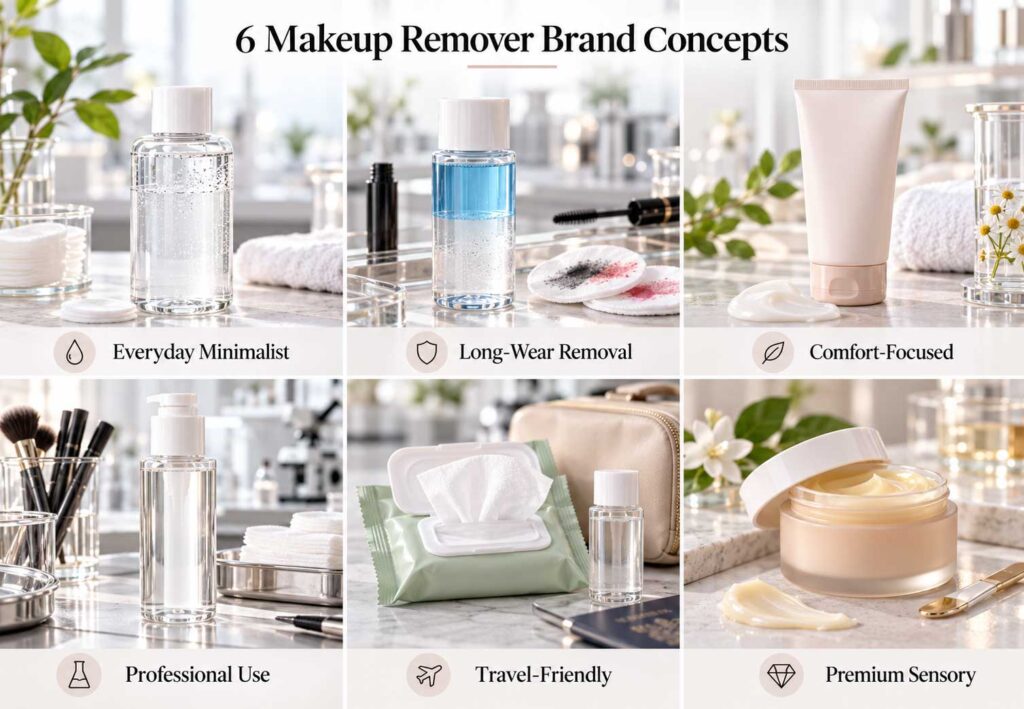
1. Everyday Minimalist Make-Up Removal
Target customers: People who wear light make-up or everyday make-up and are in search of a simple cleansing routine.
A minimalist makeup remover doesn’t need a complicated formula. It’s appealing because it seems easy to fit into an existing routine.
Picture customers with concealer, powder, tinted moisturiser and everyday lip products. They may be looking for something that seamlessly fits into their evening routine without requiring a lot of extra steps.
I would look into micellar water or a light cleansing milk as a possible starting point.
“The challenge is to differentiate. The formats are well known already and consumers have plenty of alternatives.
Rather than throw in a bunch of trendy ingredients, I’d check to see if the product can provide a significantly better experience in the areas that customers really care about — removal efficiency, residue, method of application, and packaging convenience.
First what I’d want to know: Are the target audience members frustrated enough with current daily removers to switch brands?
2. Waterproof & Long-Lasting Makeup Remover
Target consumers: Regular users of waterproof mascara, long-lasting eyeliner, transfer-proof lipstick and longwear foundation.
The idea begins with a particular performance problem.
Some makeup is designed to stay through moisture, sebum, or daily activity. It may require a different approach than removing lightweight daily makeup.
I would be looking at emulsifying balms, cleansing oils and bi-phase eye and lip removers for this brand direction.
But I wouldn’t decide on the final format until I know what makeup products customers want to get rid of.
A mascara company that emphasises water-proof formulas would be better off selling a dedicated eye makeup remover, not a facial cleansing balm.
The opportunity from a development standpoint would be to show proper makeup removal performance while maintaining an acceptable user experience.
The first thing I would want to look into: What are the hardest long-wear products and would consumers buy a remover built specifically around those products.
3. Comfortable makeup removal
Target customers: Consumers who care a lot about how their skin feels during and after it is cleansed.
There are people who aren’t big fans of the cleansing step. They might not enjoy long wiping, visible residue, or products that leave their skin feeling uncomfortable.
A brand that is all about comfort could build its identity around the experience of removing makeup, not the complexity of its ingredient list.
Selected balm formulations as well as cleansing milk, cleansing cream are suitable formulations.
I would look at the texture, spreadability, rinse or wipe off performance and the intended after feel.
It’s important to distinguish between providing a pleasant cleansing experience from making baseless claims that a product is appropriate for all with sensitive skin.
A sensitive skin marketed product must be adequately safety and claim supported.
What I’d want to learn first: Can customers describe a consistent problem with their current cleansing experience and what would be an acceptable improvement.
4. Make Up Removal Professional
Target customers: Makeup artists, salon professionals, beauty educators and consumers who apply and remove different looks of makeup often.
The professional user may have a different view on a makeup remover than the one who uses it once a nite.
They can remove lipstick during a makeup application, correct eyeliner, clean up the edges of a makeup look, or work with multiple types of colour cosmetics throughout the day.
This makes it worth looking into application control, packaging convenience and compatibility with the intended working method.
Depends on the actual tasks involved but I would consider targeted eye and lip removers, appropriate liquids for cleansing and other formats.
The most complex, most costly formula isn’t necessarily the most useful product for a professional makeup artist.
Sometimes the important details are accuracy of dispensing, predictable performance and the ability to use the product efficiently.
What I’d study first: What removal tasks are most common in professional work and whether existing products cause measurable inconvenience.
5. Travel-friendly makeup remover
Target customers: Frequent travellers, commuters, gym-goers and consumers who want portable beauty products.
This concept is based on the convenience.
A consumer might be perfectly happy with their normal cleansing oil at home but want something smaller or easier to use when they are travelling.
Some possible forms could be travel sized micellar water, compact packaging for cleansing balm and premade makeup remover pads.
I would spend as much time evaluating the packaging as I would evaluating the formula.
A convenient product becomes inconvenient if it leaks in a bag, dries out after opening, or requires awkward handling.
For wipes and pads, the finished product includes the substrate, liquid loading, package integrity and preservation system.
Care is also needed in environmental positioning. Claims of biodegradability or compostability shall be substantiated by appropriate evidence.
What I would test first: Are customers wanting a standalone travel product or are they happy with a mini version of an existing remover?
6. LUXURY IN SENSORY MAKE-UP REMOVAL
Target customers: Consumers who love skincare textures, product demonstrations and a more involved beauty routine.
The feel and behaviour of a product could be an opportunity for a premium sensory brand.
Jelly cleansers and cleansing balms are interesting formats as the texture can be visible part of the customer experience.
A balm that softens on massage or emulsifies on adding water gives the brand something meaningful to demonstrate.
But there is a difference between a pretty demo and a satisfying product.
As a manufacturer I’d be looking carefully at texture consistency, temperature stability, makeup removal and rinsing performance.
If the product looks nice online but becomes hard to use in everyday conditions, the sensory idea is not well thought out.
What I would look into first: – Do the targeted customers appreciate the experience enough to justify the suggested retail price.
How To Choose A Brand Concept That Matches Your Budget And Market
I think I would look at a few options and narrow the list to two or three ideas instead of trying to develop them all.
The goal is to find a direction that marries customer demand to something your business can actually deliver on.
I find it useful to compare possible concepts on five dimensions.
| Evaluation Factor | Suggested Weight | What to Examine |
|---|---|---|
| Customer Demand | 30% | Is there evidence of a recurring customer need? |
| Market Differentiation | 25% | Can the brand offer a meaningful reason to switch? |
| Product Feasibility | 20% | Can the product be formulated, tested, and manufactured as intended? |
| Startup Budget Fit | 15% | Can the business support the first order and launch expenses? |
| Sales Channel Fit | 10% | Does the concept suit the customers the brand can realistically reach? |
These weights are a suggested tool in decision-making, not an industry benchmark.
You can rate each concept on a scale of 1-5 in each category and come up with a weighted total. I would use the output to identify weak assumptions, not predict commercial success.
For example, a waterproof makeup remover idea might score high on customer relevance for a company that already sells mascara. That same idea might be more difficult for a founder who lacks access to the intended customers and little experience in performance-based product development.
The Budget also calls for careful consideration.
Our published contract manufacturing MOQ at Xiran Cosmetics starts at 1,000 units per product but final requirements will depend on your choice of formula, packaging and project scope.
For example, if you assume the cost of a finished product is $3.50 per unit and you want a beginning order of 1,000 units, you’ll need $3,500 just for those products. This is an example calculation, not a verified manufacturing quotation. Startup costs including development, testing, goods, and marketing would have to be considered separately.
A founder who has not yet validated customer demand may not want to pursue a product concept that requires multiple formulas, custom parts and large initial inventory.
I’d rather see a brand put one product out there that’s clearly positioned within its budget than invest in a number of ideas that are up in the air.
How to Test Your Makeup Remover Brand Idea Before You Make It
Finding a potentially attractive niche isn’t the same as proving customers will buy your product.
“Before I put big bucks into formulation development and inventory, I’d want some proof of demand.”
This does not mean that a startup needs to have an expensive market research program. That is, it means asking better questions and getting feedback from people who look like the customers you want to have.
Discuss with Customers About Their Present Routine
I would start with a small exploratory group of about 10-15 relevant consumers.
That is enough to start learning about their experiences (but not a statistically representative sample).
I wouldn’t ask, “Would you buy my new cleansing balm?” but rather, “Tell me what you are currently using.”
How often do they wear makeup What do they take it off with? Have they changed products lately? What made them change? Is there anything inconvenient for them?
The best answers usually contain information that the founder did not expect.
Someone might hate the oily residue but love cleansing balm because they don’t like using cotton pads. Other people might use the micellar water as their daily makeup, but have a separate remover for waterproof mascara.
That’s more useful than a generic survey response that a product concept sounds interesting.
Test the Formula Before Testing the Concept
If you have two promising directions, prepare simple concept descriptions.
Each needs to state the target customer, the problem, the proposed product experience and an estimated retail price.
For example,
Concept A: A light daily make-up remover for those who enjoy a simple cleansing routine with a cotton pad.
Concept B: An emulsifying cleansing balm for consumers who wear long-wear face make-up and prefer a massage-and-rinse cleansing.
These are product hypotheses, not full performance statements.
Present the concepts to the intended audience people. Ask how it compares to what they are already buying, what they would expect it to do, what would give them pause, and which is more relevant.
You can also measure interest through a landing page or email waitlist. Be clear about the product’s development status, and don’t imply that an untested or unavailable product is ready for sale.
Shopify’s market validation guide includes interviews, surveys and other methods for validating an idea before you invest more.
Search for Behaviour Not Only Positive Feedback
I would be cautious about using social media engagement as a measure of demand.
The product is interesting enough for a video to generate lots of attention. That does not mean that the viewers will buy it at the price you want.
More useful early signals are things like relevant customers signing up for a waitlist, asking for samples, comparing your product to something they already buy, or an explicit intention to buy when realistic conditions are met.
Even so, interest is not a substitute for actual sales.
If a concept doesn’t get a lot of meaningful traction, I’d re-evaluate the target customer or product promise before spending money on a custom formula.
It has been known that sometimes the right decision is to change the concept. Sometimes it is to stop after it.
Either way, a founder can shave costs.
From Brand Idea to Your First Make-up Remover Product
The subsequent step after the brand has identified a customer group and received positive feedback is to translate that direction into something that can be evaluated by a manufacturer.
This is where I would write a one page product concept brief.
Doesn’t have to be a complete list of ingredients. In fact, choosing too many ingredients too soon can complicate development.
A useful brief should contain the following information.
| Product Brief Item | Example |
|---|---|
| Target Customer | Consumers who wear long-wear foundation several times a week |
| Main Problem | Difficult makeup removal and unwanted residue |
| Proposed Product | Emulsifying cleansing balm |
| Desired Experience | Softens during massage and rinses comfortably |
| Target Market | United States |
| Preferred Packaging | 100 g jar |
| Target Retail Price | $22–$28 |
| Initial Production Quantity | 1,000 units |
| Development Route | Existing formula evaluation or customized base |
This is a concept to demonstrate, not a real customer project for Xiran.
The point is that now a manufacturer can evaluate the idea in terms of formulation capabilities, packaging options, development needs and the proposed budget.
Xiran Cosmetics offers cosmetic product development services including formula development, prototype evaluation, packaging coordination and manufacturing preparation.
A founder can start with an existing private label formula, change an appropriate base, or request full custom formulation. The right path depends on how well the available formulas match the product brief.
For more information about our offerings, visit our private label makeup remover manufacturing services including micellar water, cleansing oil, balm and other makeup remover formats.
Once you’ve settled on a product direction, you can also check our guide to developing a private label makeup remover.
One thing I would set up prior to sampling is the intended product claim.
If the brand wants to claim that its remover is for sensitive skin, can remove waterproof makeup or is safe to use around the eyes, those claims have to be factored into planning for product safety and testing.
FDA’s cosmetics guidance outlines manufacturers’ obligations to ensure product safety. Regulation (EU) No 655/2013 of the European Parliament and of the Council lays down common criteria for supporting cosmetic product claims.
I would much rather nail down realistic product requirements up front than find out near launch that a marketing claim we planned can’t be supported.
Final Thoughts: Find a Customer Worth Serving Before Choosing a Formula
You don’t need a revolutionary formula to launch a makeup remover brand. You need to know exactly who the product is for, and why those customers would choose it over what they’re already using.
I would rather have a founder spend some time researching a particular problem that a customer has than rush into creating a large collection of products without a clear positioning.
Reach out to a group of consumers you can reach. Understand makeup habits and frustrations. Look at the existing alternatives they use, and then test if your improvement is enough to make a difference in a purchase.
Once you have answered those questions, the first product choice is a lot easier.
Xiran Cosmetics helps brands turn product ideas into private label and custom cosmetic formulations. If you have an idea for a potential makeup remover niche but haven’t decided on the final formula, you can contact our team to talk about what product and packaging options would be appropriate.
It’s not about creating as many makeup removers as you can. The point is to build the first one your customers have a real reason to buy.
Frequently Asked Questions About Makeup Remover Brand Ideas
How Do I Start a Makeup Remover Brand Without a Product Idea?
Start by identifying a customer group rather than choosing a formula. Research the makeup they use, how they remove it, what they dislike about existing products, and which alternatives they already buy. From there, develop two or three possible brand concepts and discuss them with relevant consumers.
I would only narrow the decision to a specific product format after finding a problem worth solving. A clear target customer and product purpose are more valuable than an early list of fashionable ingredients.
How Do I Find a Profitable Niche for My Makeup Remover Brand?
A promising niche needs more than an interesting customer problem. I would examine consumer demand, competing products, expected selling prices, manufacturing costs, and the channels available to reach those customers. Look for repeated dissatisfaction with existing products, then investigate whether customers would pay for an improvement.
A niche is not profitable simply because it appears underserved. The business must be able to acquire customers, deliver the product at an acceptable cost, and generate enough margin to support continued operations.
Who Should I Target With My First Makeup Remover Product?
I recommend targeting a clearly defined group whose makeup removal needs you can understand and research. That might be everyday makeup users, people who regularly wear waterproof cosmetics, professional makeup artists, or consumers seeking portable products.
The best audience is not necessarily the largest. A founder with an existing makeup brand may have an advantage in developing a complementary remover for current customers. If you don’t already have an audience, customer interviews and competitor research become especially important before choosing the first product.
How Can I Make My Makeup Remover Brand Different From Competitors?
Differentiation can come from cleansing performance, texture, application method, packaging, convenience, or a clear focus on a specific customer. It does not always require a completely new ingredient or exclusive formula. I would begin by understanding what competing products already do well and where customers remain dissatisfied.
Then choose an improvement that the finished product can actually deliver. A different bottle colour or a longer ingredient list may change the appearance, but neither automatically gives customers a convincing reason to switch brands.
Can a Cosmetics Manufacturer Help Me Develop a Makeup Remover Brand Idea?
Yes. A manufacturer with formulation and product development capabilities can help assess whether your concept is technically practical and identify suitable product formats, existing formulas, packaging options, and development requirements. However, I believe the brand owner should first have a reasonable understanding of the intended customer and commercial positioning.
At Xiran Cosmetics, we can discuss a concept before every technical detail has been finalized. A useful starting brief includes the target customer, problem to solve, sales market, preferred product experience, budget, and expected quantity.